In production Β· v0.100.0 Β· Debian 12 & 13

Run a fleet of servers from one screen.

Hyperion is a self-hosted, multi-node hosting control panel written in Rust. It provisions sites end to end in one atomic transaction β€” then runs the day-to-day of a hosting business: backups and off-site copies, WordPress updates and repairs, a per-site WAF, monitoring and paid care plans with monthly customer reports.

Rust Β· stable AGPL-3.0 Debian 12 | 13 OpenAPI 3 #![forbid(unsafe_code)]
1 master Β· N workers Β· signed RPC
PHP 8.1–8.4Β·MariaDB / PostgreSQLΒ· Let's EncryptΒ·WordPressΒ· Redis cacheΒ·S3 + age backupsΒ· OWASP CRS WAFΒ·nftables firewallΒ· Per-site DKIMΒ·Malware scanΒ· Care plansΒ·Customer reportsΒ· restic snapshotsΒ·Git deployΒ· Docker monitoringΒ·Slack alertsΒ· BLAKE3 audit chainΒ·Ed25519 RPCΒ· REST APIΒ·OpenAPI 3Β· Panel importΒ·hctl remoteΒ·
3,500+
Tests, run on every change
∞
Worker nodes per master
0%
unsafe code, every crate
0
Production deployments

Why Hyperion

The same job most panels do β€” without trusting 10,000 lines of bash-by-stringification.

Most open-source panels are PHP wrappers around templated shell: thousands of lines of string-built commands running as root, where a domain with an odd character can turn a config write into unintended shell. Hyperion does the same job from a Rust core where every system command is built from typed, pre-validated arguments β€” and it manages several servers from the start.

β€œEvery adapter takes pre-validated typed arguments and shells out only via Command::new(..).arg(..) β€” no shell interpolation, ever. Failure at any step rolls back the rest. No orphan rows, no zombie users.”
Capability
Hestia / Vesta
Hyperion
Memory-safe language
PHP + bash
Rust
Multi-node cluster
single node
master + N workers
Atomic provisioning
partial
rollback on every step
Scriptable HTTP API (OpenAPI) + CLI
partial / unofficial
/api/v1 + hctl
Live progress for long operations
β€”
job page with sub-steps
Tamper-evident audit log
β€”
BLAKE3 hash chain
Off-site backups
FTP
S3 (age-encrypted) + FTP/FTPS/SFTP
Import from HestiaCP / CloudPanel
β€”
in place, over SSH, or exporter
Import a WordPress site from any host
β€”
plugin + a pasted code

vs. HestiaCP Β· Vesta Β· aaPanel Β· live from README

The panel

One screen for the whole fleet

axum + Askama + HTMX in one binary, no JavaScript build step. What needs attention, live throughput, every site in the cluster and each site's health β€” dark and light themes out of the box.

https://panel.example.com
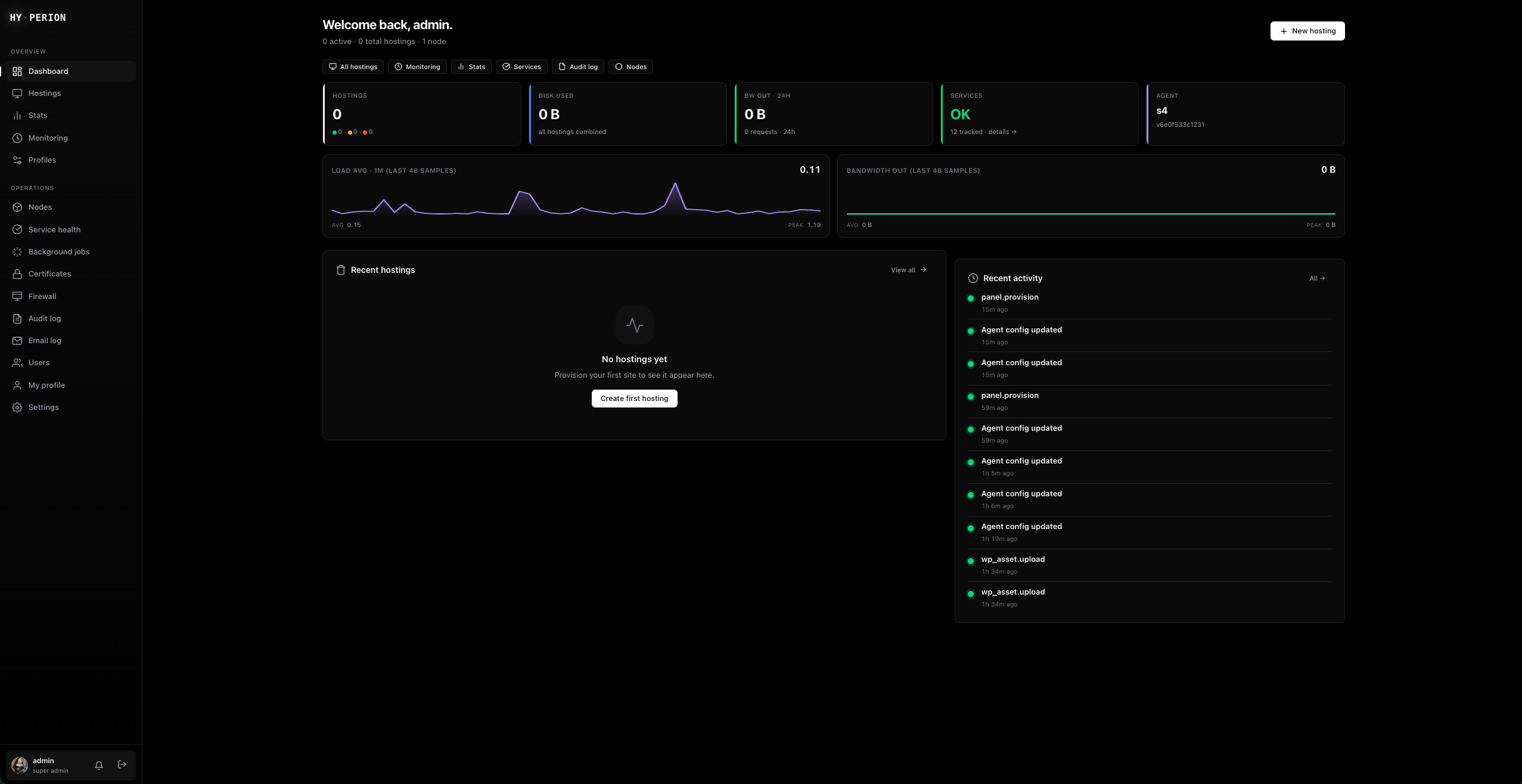
Hyperion dashboard β€” what needs attention, load, live network throughput, recent backups and activity

Dashboard β€” what needs attention, load, live network throughput, recent backups and activity.

/stats β€” cluster
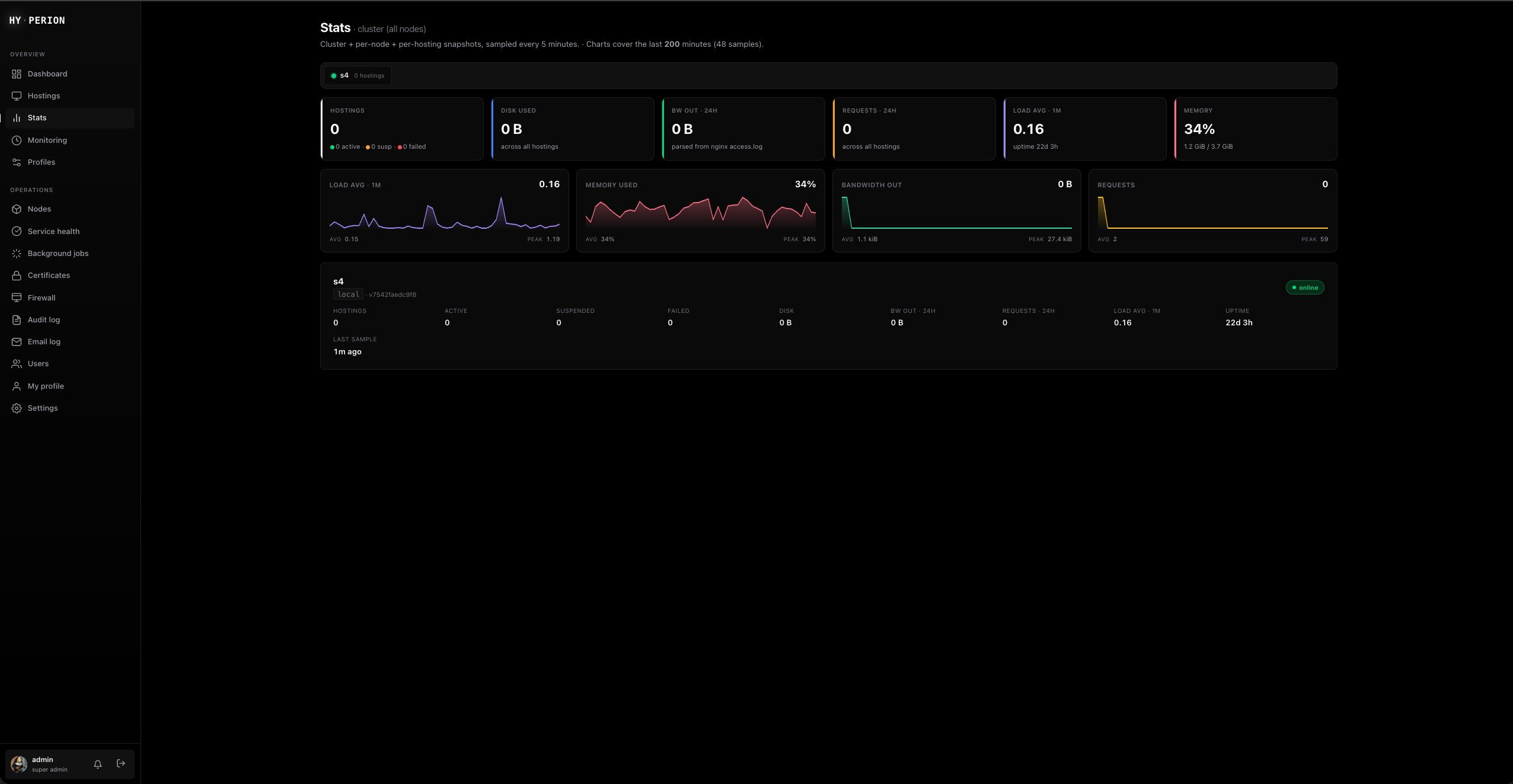
Cluster stats β€” per-node and per-site metrics with a realtime network graph
Cluster stats. Per-node metrics, per-site CPU / RAM / disk / traffic, a realtime network graph.
/hostings
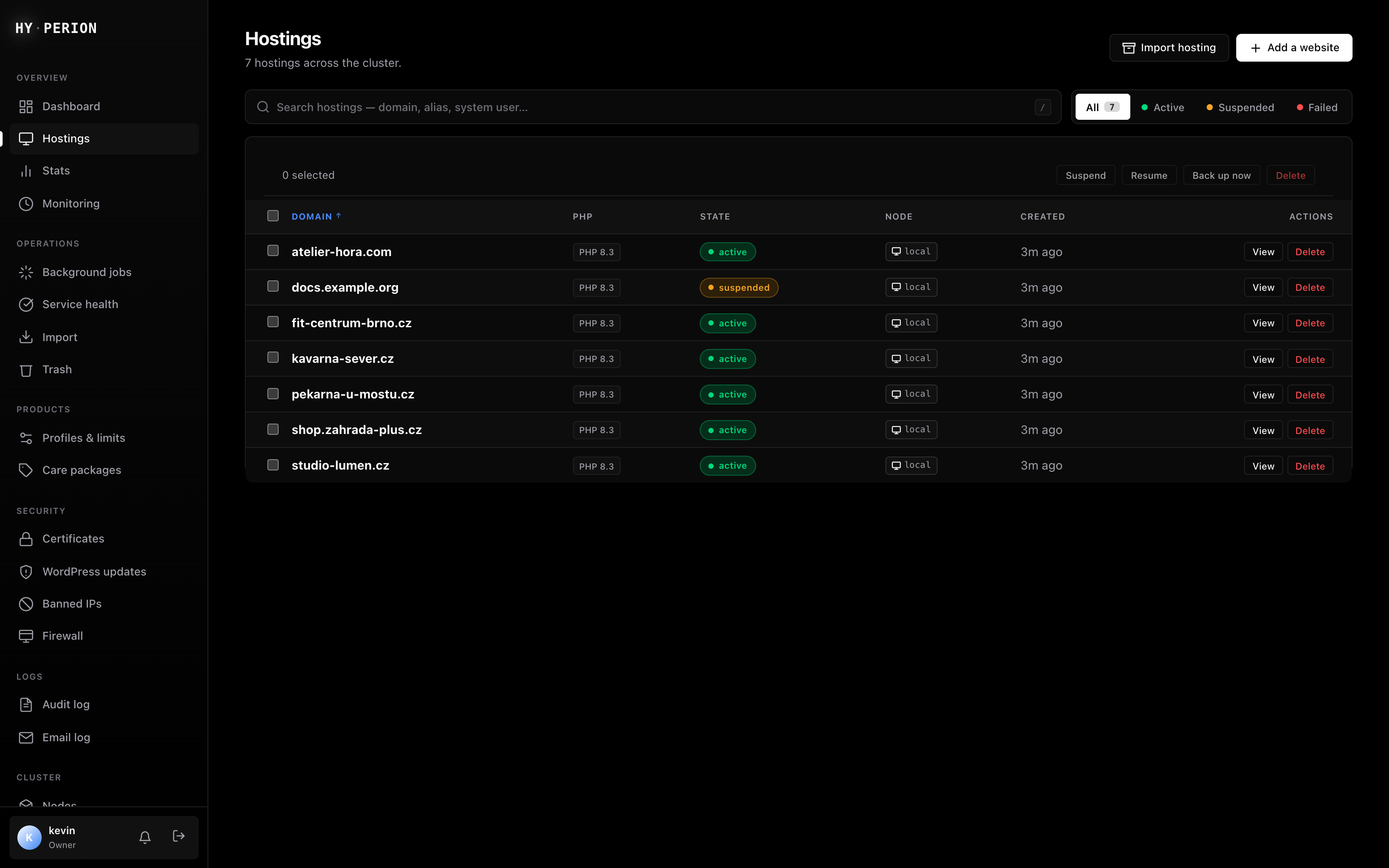
Hostings list β€” every site in the cluster with state, PHP, node and bulk actions
Hostings. Every site with its state, PHP and node, a needs-attention filter and bulk actions.
/hostings/example.com
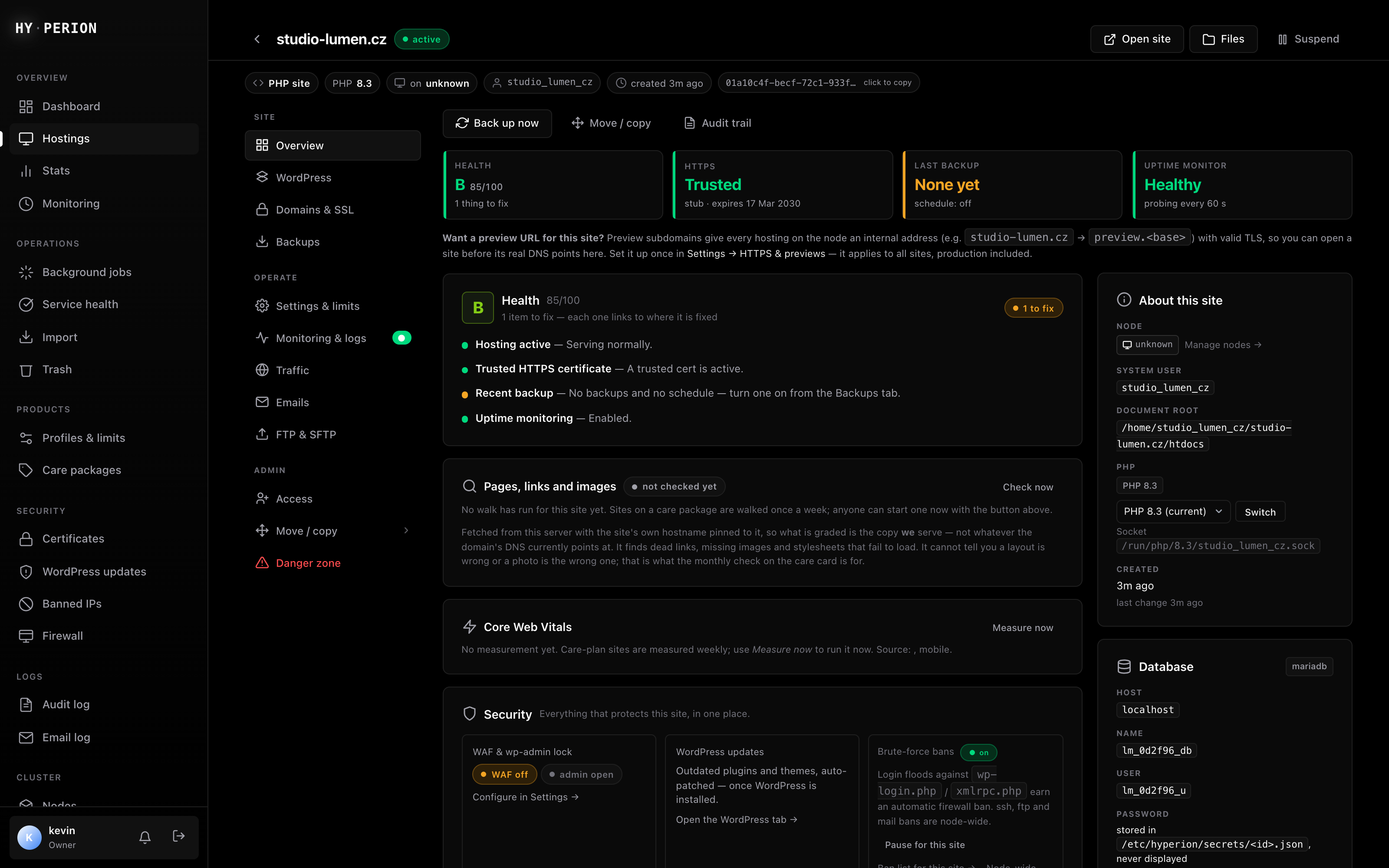
Site detail β€” health, HTTPS, backups, uptime, security, WordPress and database tabs
Site detail. Health, HTTPS, backups, uptime, security, WordPress and database in tabs.

Features

Everything a hosting business runs on

Sites, WordPress, backups, security, mail, monitoring and paid care plans β€” surfaced in the UI, the CLI and the REST API.

Add a website β€” atomic, or not at all

A type-first flow for WordPress, plain PHP, static sites and reverse proxies (Node.js, Python, Docker or any upstream). Linux user, PHP-FPM pool, database, vhost and certificate are created in one transaction; a failure undoes the finished steps.

βœ“user + FPM pool
βœ“database + vhost
●TLS certificate

PHP 8.1 β†’ 8.4, side by side

Per-site PHP settings, MariaDB or PostgreSQL, and one-click phpMyAdmin relayed through the panel β€” never exposed on the network. Builds hit by known advisories get flagged.

8.1 8.2 8.3 8.4

WordPress that fixes itself

An Updates page that sorts every site by what it needs, Site health that names the plugin behind a fatal error and parks it, checksum repair, and staging β†’ push-to-prod behind a backup.

Integrity & malware scan, without running site code

The agent compares core, plugins and themes with their release and reads every other file for known malware patterns β€” no wp-cli, nothing executed. Results say what was and was not covered; changes it can't judge wait as "to review" until you trust or quarantine them.

coreβœ“ matches
pluginsβœ“ matches
uploads/x.phpto review

Backups that leave the box

Scheduled files + database backups, off-site to S3 (client-side age encryption) or FTP / FTPS / SFTP, restic snapshots with diff, and a full backup before every automatic WordPress update. Restore everything, only the DB, or only files β€” or into a new domain.

localβœ“ verified
S3 Β· ageβœ“ off-site
pre-updateβœ“ 24 h

Every slow action is a background job

Create, backup, restore, import, certificate, WordPress install β€” each runs on the server with per-step progress that survives closing the browser.

Mail that gets delivered

Site mail goes through the server's own postfix with per-site DKIM signing and SPF checks, a server-wide email log with delivery verdicts, and a WordPress mail self-repair.

Monitoring and a notification centre

Live CPU, memory, disk, pressure (PSI) and network gauges, per-site resource use, HTTP uptime checks, OOM kills and pending reboots β€” plus an optional read-only Docker module for Compose stacks. Alerts from every node arrive by e-mail (with your logo) and Slack.

CPU RAM network uptime Docker Slack
For agencies Β· care plans

Sell maintenance, and prove it every month

Care packages bundle backups, updates, checks, monitoring, the firewall (Standard, Strict or the OWASP Core Rule Set) and brute-force protection into a paid plan that's enforced on its sites. Each month every customer gets a report β€” updates, backups, uptime, load speed and Core Web Vitals β€” in English, Czech or any language you translate.

example.com Β· Care PlusNov
updates14 applied
backups30 / 30
uptime99.98 %
LCP1.4 s
WAF blocks312
Migrate in

Move off HestiaCP, CloudPanel β€” or any WordPress host

Hyperion reads the source panel's own state (Hestia *.conf, CloudPanel's SQLite) instead of scraping it. A dry run shows what would be created, skipped or in conflict; an existing domain is never overwritten. WordPress comes across with wp-config.php repointed. Mail and DNS are reported, not migrated.

Command
static exporter, resumable upload, no inbound SSH
SSH
key used for one run, then deleted
WordPress plugin
paste a code, no shell on the host
Hyperion
from another Hyperion node

Git deploy

From a GitHub repo (public, deploy key or token) with a push webhook. Runs as the site's user; .git is never served.

Let's Encrypt

HTTP-01 with auto-renewal, also behind Cloudflare, and DNS-01 wildcards that renew themselves via acme-dns.

Self-tuning limits

Kernel disk quotas, bandwidth alerts, and PHP memory & workers that rise when a site needs them and settle back down.

Profiles & lifecycle

Linked profiles you can re-apply, preview addresses before DNS moves, expiry, trash with restore, move or copy between nodes.

Live Β· feature index

47 shipped features, in the project's own words

Read live from the README's feature list on every visit, so it grows on its own as features land. The full detail lives in the manual.

Sites

10
  • βœ“Create in one step
  • βœ“PHP 8.1–8.4 side by side
  • βœ“MariaDB or PostgreSQL
  • βœ“Let's Encrypt
  • βœ“Preview address
  • βœ“File manager, cron editor, log viewer
  • βœ“Git deploy
  • βœ“Lifecycle
  • βœ“Profiles
  • βœ“Limits

WordPress

6
  • βœ“Install with the site
  • βœ“Updates page
  • βœ“Site health
  • βœ“Repair
  • βœ“Integrity and malware scan
  • βœ“Staging copy

Backups

6
  • βœ“Scheduled and on-demand backups
  • βœ“Off-site copies
  • βœ“Backup before every automatic update
  • βœ“Cleanup
  • βœ“restic snapshots
  • βœ“Restore everything

Security

8
  • βœ“#![forbid(unsafe_code)] in every crate
  • βœ“Two-factor auth
  • βœ“WAF
  • βœ“Brute-force protection
  • βœ“Firewall
  • βœ“Per-site country blocking
  • βœ“Audit log
  • βœ“Every site is its own Linux user

Mail

3
  • βœ“Site mail goes through the server's own postfix
  • βœ“An email log for the whole server
  • βœ“Postfix's message size limit can be set from the panel

Monitoring and notifications

6
  • βœ“Live CPU, memory
  • βœ“HTTP uptime monitoring
  • βœ“An optional Docker module for the Compose stacks on your nodes
  • βœ“OOM kills, a read-only root filesystem
  • βœ“A Service health page
  • βœ“A notification centre

Care plans

4
  • βœ“Care packages
  • βœ“A monthly service checklist per site
  • βœ“Monthly customer reports
  • βœ“Every customer-facing sentence is translatable

Cluster

2
  • βœ“A master plus any number of workers
  • βœ“Load-aware placement of new sites

Panel and access

2
  • βœ“axum + Askama + HTMX in one binary
  • βœ“Five built-in roles

Multi-node cluster

One master. A fleet of workers. Signed end to end.

The master holds the UI, audit log and node registry. Workers run an agent the master drives over Ed25519-signed RPC β€” canonical JSON over HTTPS on port 9443, optionally over a private network, with certificate pinning. Node responses are authenticated too.

  • β˜…
    Load-aware placement. New sites land on the node with room for them, and every page has a node switcher.
  • ⇄
    Move and copy between nodes. Files, database and the site's settings come across, with live progress the whole way.
  • ↻
    Remote node updates. Updates wait for running jobs, roll back if the new build doesn't come up, and can run on their own.

Enroll a worker in ~30 seconds: Nodes β†’ Generate invite β†’ paste the printed one-liner on another Debian server.

master
web UI
:8443
s1
s2
s3
s4
s5
s6

Architecture

Two layers per box

A privileged agent owns all system state; an unprivileged web binary talks to it over a local Unix socket. Every adapter takes typed, pre-validated arguments and runs commands only through Command::new(..).arg(..) β€” never format!() into a shell.

master only

hyperion-web

Serves the UI, the setup wizard and /api/v1. Runs unprivileged and owns the audit log, web users, session ledger, node registry and the Ed25519 master signing key.

audit chain sessions nodes registry master signer /api/v1
runs as root

hyperion-agent

Owns all system state β€” users, directories, nginx vhosts, FPM pools, databases, certificates, FTP, cron, backups, firewall. Listens on /run/hyperion.sock (0660, group hyperion-admin); on workers, also :9443 for signed RPC.

fs / users nginx / php mysql / pg acme / bkup wp / ftp firewall
Transport
HTTPS :9443

private network + certificate pinning

RPC envelope
Ed25519-signed

canonical JSON, responses authenticated too

Workspace
10 crates Β· 4 bins

93 schema migrations

Security

Security-first, not security-eventually

The agent runs as root and a customer's webroot is attacker-controlled, so the design assumes it. Memory-safe to the core, signed at every boundary, tamper-evident by construction.

#![forbid(unsafe_code)]

In every crate. Argon2id passwords, Ed25519-signed sessions with a revocation ledger, and roles re-checked on every request β€” a demoted user loses access at once.

WAF + OWASP Core Rule Set

Per-site Standard and Strict levels with per-rule overrides, plus an opt-in ModSecurity v3 CRS tier. The Protection page shows what was blocked and helps tune false positives.

Firewall & brute-force bans

nftables ban sets for the panel, SSH, FTP, mail and WordPress logins with escalation for repeat offenders, and a panel-managed firewall that never locks out the panel or cluster ports.

2FA, mandatory for admins

With backup codes and a list of signed-in devices you can sign out. Custom roles are built from individual capabilities.

One Linux user per site

Privileged file operations in a customer's webroot resolve symlinks component by component, and secrets never appear on a command line. GeoIP and bot blocking per site.

BLAKE3 audit chain

A tamper-evident hash chain over every state change, with per-node verification, search and CSV export.

On every response: CSPΒ· HSTSΒ· X-Frame-OptionsΒ· Permissions-PolicyΒ· Referrer-PolicyΒ· Per-form CSRF tokens

Command line

hctl β€” when the web can't help

On the node, hctl talks to the agent over its Unix socket β€” so it keeps working when the panel is down, you're locked out, or the firewall only lets SSH in.

  • β†’Hostings, backups, snapshots, certificates, WordPress, mail, DKIM, cron, bans, nodes and the audit chain.
  • β†’Locked out? hctl user unlock, hctl user disable-2fa, hctl firewall disable-drop.
  • β†’hctl remote drives any panel's /api/v1 from any machine.
  • β†’No command takes a password on argv; --json on everything for jq.
root@node ~ hctl
$ hctl hosting create example.com --alias www.example.com --php 8.3 --db mariadb
$ hctl hosting create app.example.com --proxy http://127.0.0.1:3000

$ hctl backup now example.com
$ hctl backup restore example.com 42 --mode db --yes

$ hctl wp integrity-scan example.com
$ hctl dkim verify example.com
$ hctl audit verify

# off-box, over the HTTP API
$ hctl remote list --state active | jq '.items[].domain'
$ β–‹

Scriptable

Drive the whole fleet over HTTP

A Bearer-authenticated /api/v1 for provisioning and running the cluster from CI, cron or your own tools. Lists paginate, slow operations return 202 {job_id} you poll, errors come as a JSON envelope β€” and the OpenAPI contract is generated from the handlers, so it can't drift.

curl Β· /api/v1
$ curl -H "Authorization: Bearer hyp_…" \
     https://panel.example.com/api/v1/hostings

{
  "items": [
    { "id": "01K4Z…", "domain": "example.com",
      "state": "active", … }
  ],
  "next_cursor": null, "total": 12
}

$ curl -X POST …/api/v1/hostings \
     -d '{"domain":"new.example.com","php":"8.3"}'
HTTP/1.1 202 Accepted
{ "job_id": "01K5…", "status": "accepted" }

$ hctl remote backup new.example.com --wait β–‹

Bearer auth

A key from Administration β†’ API keys, sent as Bearer hyp_… β€” shown once, stored only as a hash.

Scoped, owner-clamped keys

A capability bitmask + tenant scope, clamped to ≀ the owner at mint and re-clamped on every call. Demote a user and its keys shrink instantly.

Allowlist + rate limit

Per-key CIDR IP allowlist and a per-key rate limit β€” over budget returns 429 with a Retry-After.

OpenAPI 3, self-hosted

Machine contract at /api/v1/openapi.json, rendered docs at /api/v1/docs. No SaaS, no upload.

Endpoint reference 21 routes Β· JSON Β· live from source
GET/me
GET/nodes
GET/jobs/{id}
GET/hostings
POST/hostings
GET/hostings/{id}
DEL/hostings/{id}
POST/hostings/{id}/suspend
POST/hostings/{id}/resume
PATCH/hostings/{id}/limits
PATCH/hostings/{id}/php
PATCH/hostings/{id}/vhost
PATCH/hostings/{id}/expiry
PATCH/hostings/{id}/quota
POST/hostings/{id}/backup
GET/hostings/{id}/backups
POST/hostings/{id}/cert
POST/hostings/{id}/wp/install
POST/hostings/{id}/wp/core-update
POST/hostings/{id}/restore
POST/certs/renew-all

Live Β· from main

Straight from the repo

This page reads GitHub on load β€” version, status, stars, the comparison, the feature index, the endpoint reference and the commits below all update themselves as the project ships. No redeploy, no stale numbers.

Roadmap
HA control plane (warm standby + state replication) Β· SSO / OIDC login
Full history on GitHub

Install

One command, then a setup wizard

On a fresh Debian 12 or 13 server, as root. The installer checks that ports 80, 443 and 8443 are free, installs nginx and postfix, downloads pre-built binaries verified against SHA256SUMS, and prints a one-time setup link.

$
curl -fsSL https://raw.githubusercontent.com/nechodom/hyperion/main/packaging/install/install-master.sh | sudo bash

This pipes a script into root β€” read it first. Re-running it is safe; HYPERION_ADMIN_PASS skips the wizard for automation.

01

Run the setup wizard

Admin account with mandatory 2FA, pick PHP / MariaDB / PostgreSQL / Redis / phpMyAdmin with live progress, then the panel domain, mail and S3 backups.

02

Add worker nodes

Nodes β†’ Generate invite β†’ paste the one-liner on another Debian server. It enrolls in about 30 seconds.

03

Stay current

sudo hyperion update waits for running jobs and rolls back if the new build doesn't come up. Auto-update is opt-in.